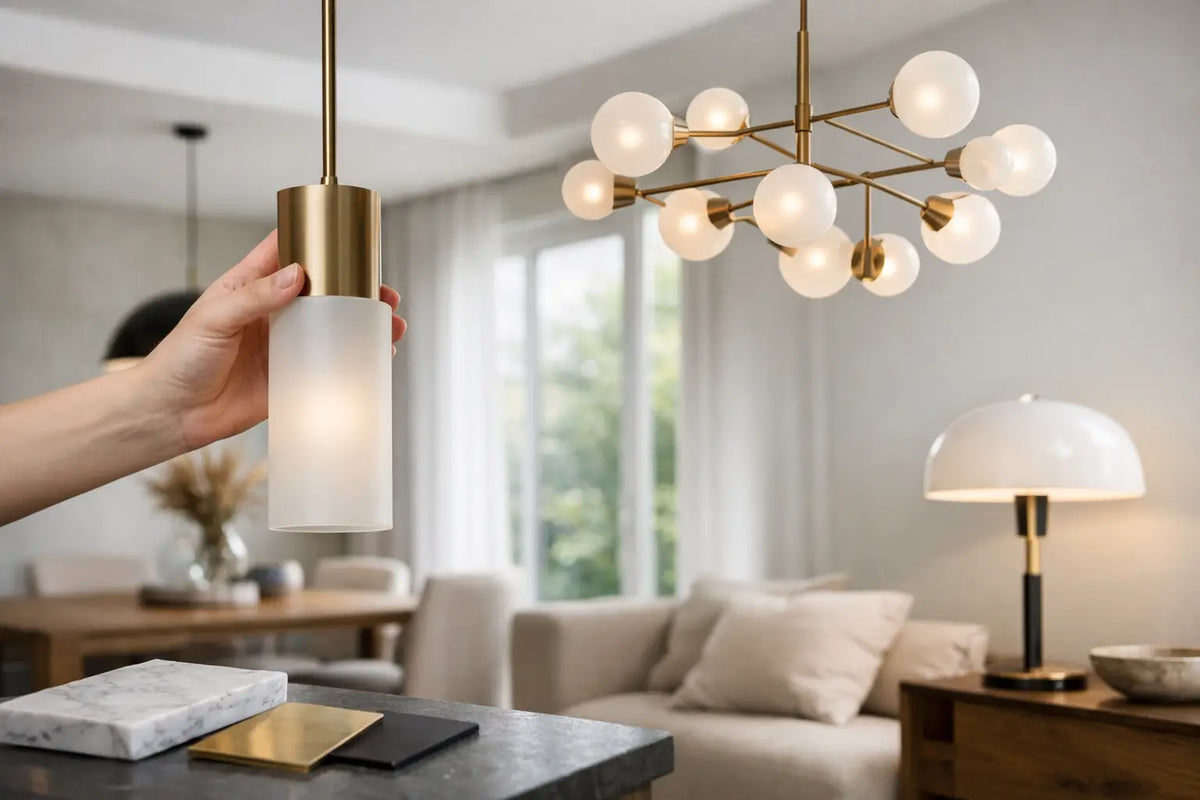
A beautiful pendant can lose its authority when hung too high above a dining table. A sculptural floor lamp can become an obstacle if it has not been considered alongside seating, circulation and sightlines. Knowing how to choose designer lighting begins with this principle: a fitting is never an isolated object. It is part of the architecture of a room, shaping how surfaces read, how people move and how a home feels after daylight has gone.
Designer lighting earns its place through proportion, materiality, technical performance and the quality of light it creates. The most successful schemes are composed early, considered alongside joinery, furniture layouts and finishes, then refined to suit the rituals of daily life.
Begin with the room, not the fitting
It is tempting to start with the statement piece. In a considered interior, however, the room determines the lighting rather than the reverse. Assess its scale, ceiling height, natural light, principal views and intended use before narrowing the aesthetic direction.
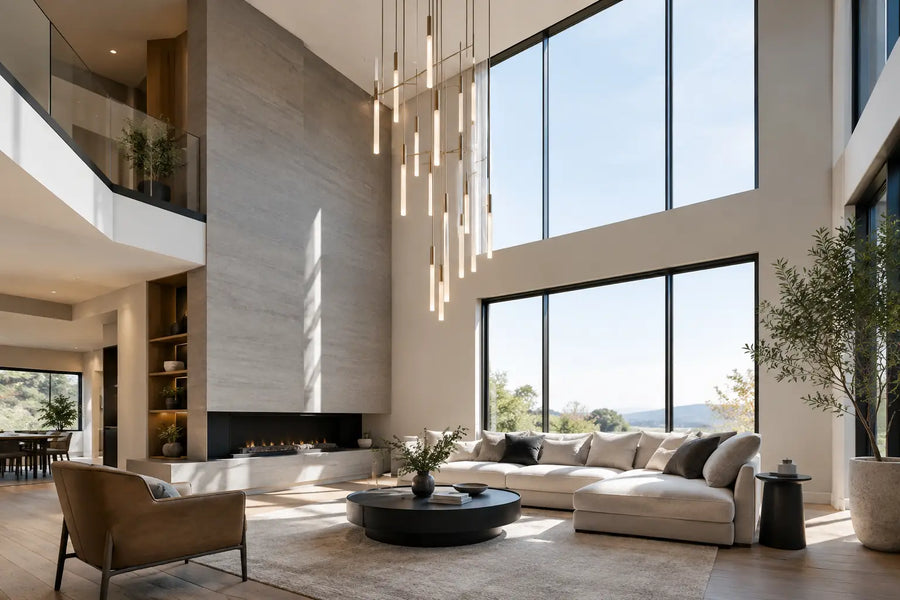
A double-height entrance may have the volume for an architectural chandelier with a generous drop. In a lower-ceilinged drawing room, a wide but shallow ceiling light, paired with floor and table lamps, can provide greater presence without making the room feel compressed. Equally, a compact dining area may benefit from a single decisive pendant rather than several small fittings competing overhead.
Furniture placement matters just as much. A pendant should relate to the dining table beneath it, not merely the centre of the ceiling. Bedside lighting should be planned around the height of the mattress, headboard and bedside tables. In a seating area, the visual weight of a floor lamp should balance the sofa, occasional chairs and surrounding artwork. This is why lighting plans are best resolved once a spatial layout is established.
Create a layered lighting scheme
One ceiling fitting rarely produces a convincing room. It may provide general illumination, but it cannot offer the intimacy, emphasis and adaptability expected of a well-designed home. A layered scheme uses different sources for different purposes.
Ambient lighting establishes the overall level of illumination. This may come from ceiling-mounted fittings, discreet architectural lighting or indirect light washing across a ceiling. Task lighting supports practical activities: reading lamps, directional bedside lights, well-positioned kitchen lighting and focused illumination at a dressing table. Accent lighting is more selective, drawing attention to art, textured wall finishes, sculpture or an exceptional material.
Decorative lighting is the visible jewellery of the scheme. A hand-blown glass chandelier, alabaster wall light or finely detailed bronze lamp brings character even when unlit. Yet decorative lighting should not be asked to perform every role. A dining chandelier may create atmosphere, for example, while subtle perimeter lighting ensures the room still works for serving, entertaining and clearing away.
The balance changes from room to room. A kitchen needs clear, shadow-free task lighting at worktops, with more restrained ambient light for evening use. A bedroom benefits from softer pools of light and independently controlled bedside fittings. In a cinema room, low-level navigation lighting and concealed detailing are generally more appropriate than visual drama overhead.
How to choose designer lighting at the right scale
Scale is one of the most frequent sources of disappointment. A fitting can be beautifully made yet feel insignificant in a generous room, or overwhelm a more intimate setting through its diameter, drop or visual density.
Start with the physical dimensions, but do not stop there. A transparent glass chandelier occupies space differently from a dense metal fitting of the same size. A linear pendant can appear lighter than a globe cluster, while a piece with dark finishes may read as more substantial against a pale ceiling. Consider its apparent volume as well as its measured width.
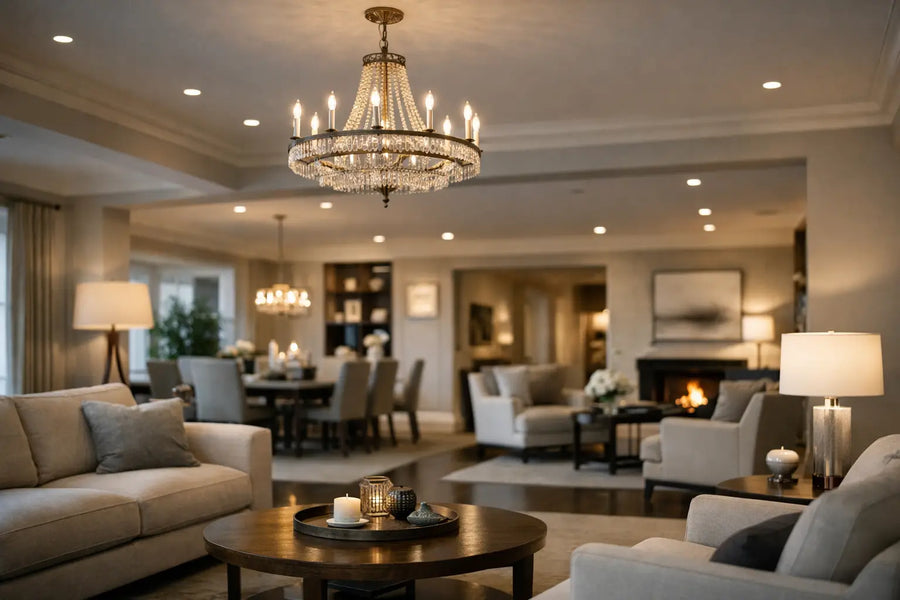
Above a dining table, the fitting should be clearly connected to the table rather than stretching beyond its edges or appearing timidly narrow. Leave sufficient visual breathing room at either end. The drop is equally important: it should allow conversation across the table and preserve views through the room, while sitting low enough to create a sense of occasion.
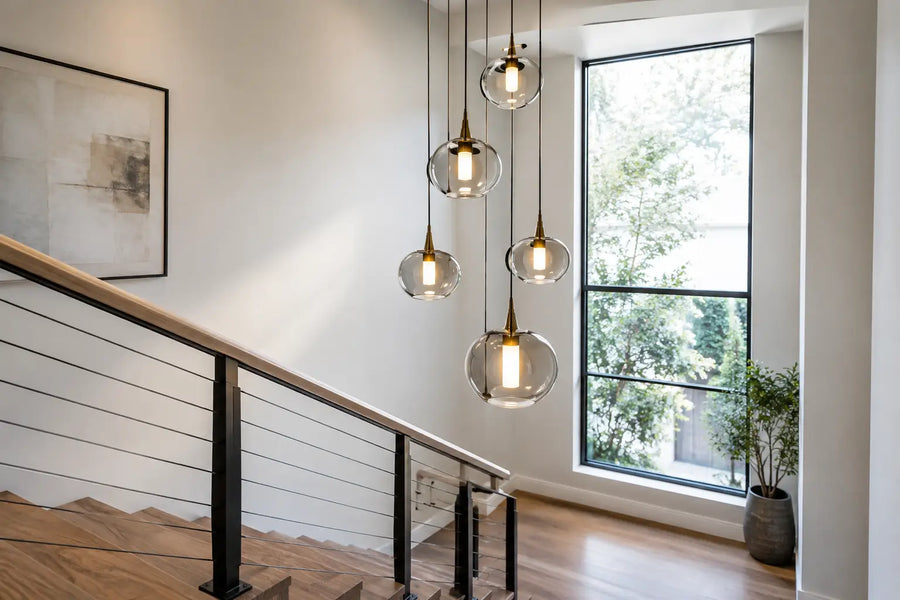
In hallways and stairwells, assess the composition from every approach. A staircase light is seen from below, above and across landings, often against changing architectural backgrounds. Its vertical proportion needs to make sense over the full journey, not simply from the entrance door.
Wall lights deserve the same care. Their height should relate to furniture, artwork and eye level, while their projection must leave circulation comfortable. In narrow corridors, a shallow-profile design may be more appropriate than a fitting with dramatic depth.
Consider light quality, colour and control
The beauty of a light fitting is only half the story. The lamp source and controls determine how its material, colour and form are experienced. A scheme with poor light quality can flatten exquisite finishes and make a carefully furnished room feel unexpectedly harsh.
For residential settings, warm white light is usually the most flattering choice, particularly in living spaces, bedrooms and dining rooms. It complements timber, stone, brass, textured plaster and natural fabrics, allowing their depth to remain visible after dark. Cooler light may have a place in highly functional areas, but it often feels clinical when used indiscriminately throughout a home.
Colour rendering is another quiet but significant consideration. High-quality sources reveal the true tones of artwork, upholstery, timber and skin. This matters in interiors where materials have been selected with precision. A rich mohair, veined marble or layered wall finish should not appear dull or distorted under artificial light.
Dimming is essential in principal rooms. It permits one scheme to serve breakfast, work, family time and formal entertaining without changing the fittings themselves. Specify compatible dimming systems from the outset, as not every LED source responds in the same way. Poor compatibility can lead to flicker, limited dimming range or audible buzzing, all of which undermine an otherwise refined installation.
Controls should follow how the household lives. Scene settings can bring several layers together at a single touch, but simple, intuitive wall controls remain valuable. A guest should be able to enter a room and understand how to create comfortable light without instruction.
Match materials to the interior's character
Designer lighting often introduces a material contrast that gives a room its depth. Bronze can anchor a contemporary scheme with warmth and gravitas. Hand-finished plaster or ceramic can soften a modern architectural setting. Glass may introduce delicacy, reflection and movement, while alabaster offers a gentle luminosity that changes subtly when illuminated.
The aim is not to match every metal finish. A room with brass hardware does not require brass lighting throughout. A more nuanced composition might combine aged brass with dark bronze, or polished nickel with soft grey stone, provided the finishes share an underlying temperature and level of refinement.
Consider how materials will age. Lacquered surfaces, natural metals and hand-applied finishes develop differently over time. In some homes, a living patina is desirable, adding depth and individuality. In others, a more stable finish is preferable for consistency. This is a practical decision as much as an aesthetic one, particularly in coastal properties, kitchens and high-use family spaces.
Respect the architecture and technical brief
Lighting must work with the building rather than against it. Ceiling voids, joist positions, existing services and the weight of a fitting can all influence what is possible. A substantial chandelier may require structural support; a recessed fitting requires appropriate depth; wall lights need cabling planned before finishes are complete.
Early coordination also prevents compromises around joinery and artwork. Integrated shelf lighting, illuminated wardrobes, concealed curtain-pocket lighting and picture lights are most successful when designed into the architecture. Retrofitting can be possible, but it rarely achieves the same clarity.
For bathrooms and exterior areas, technical suitability is non-negotiable. Fittings must have the correct rating for their location and be specified with moisture, weather exposure and maintenance in mind. A decorative choice that is unsuitable for the environment will not age gracefully.
Invest in pieces with lasting relevance
The most enduring designer lighting does not depend on novelty. It has a clear relationship with its materials, an assured silhouette and a level of craftsmanship visible in the details: the weight of metalwork, quality of glass, finish of a canopy and precision of assembly.
This does not mean every fitting must be restrained. A sculptural chandelier can be richly expressive, particularly in an entrance hall or formal dining room. The question is whether it belongs to the architecture and the wider collection of objects in the home. Distinctive choices last when they feel intentional rather than merely conspicuous.
It is also wise to distinguish between decorative impact and practical permanence. A highly intricate fitting may be right for a low-touch formal space, while a family kitchen may call for a design that is easier to clean, re-lamp and maintain. Exceptional interiors account for both the photograph and the ordinary Tuesday evening.
Lighting is often the element that gives a completed room its final sense of rhythm. Take time to view samples after dark, test dimming levels and stand in the room from different angles before committing. The right decision will not only illuminate the architecture - it will allow the people, materials and moments within it to be seen at their best.
Touched Interiors
The Insider is written by the Touched Interiors design studio in Manchester, founded by Kunal Trehan in 2009 and named Interior Design Studio of the Year in 2024 and 2025. About the studio.