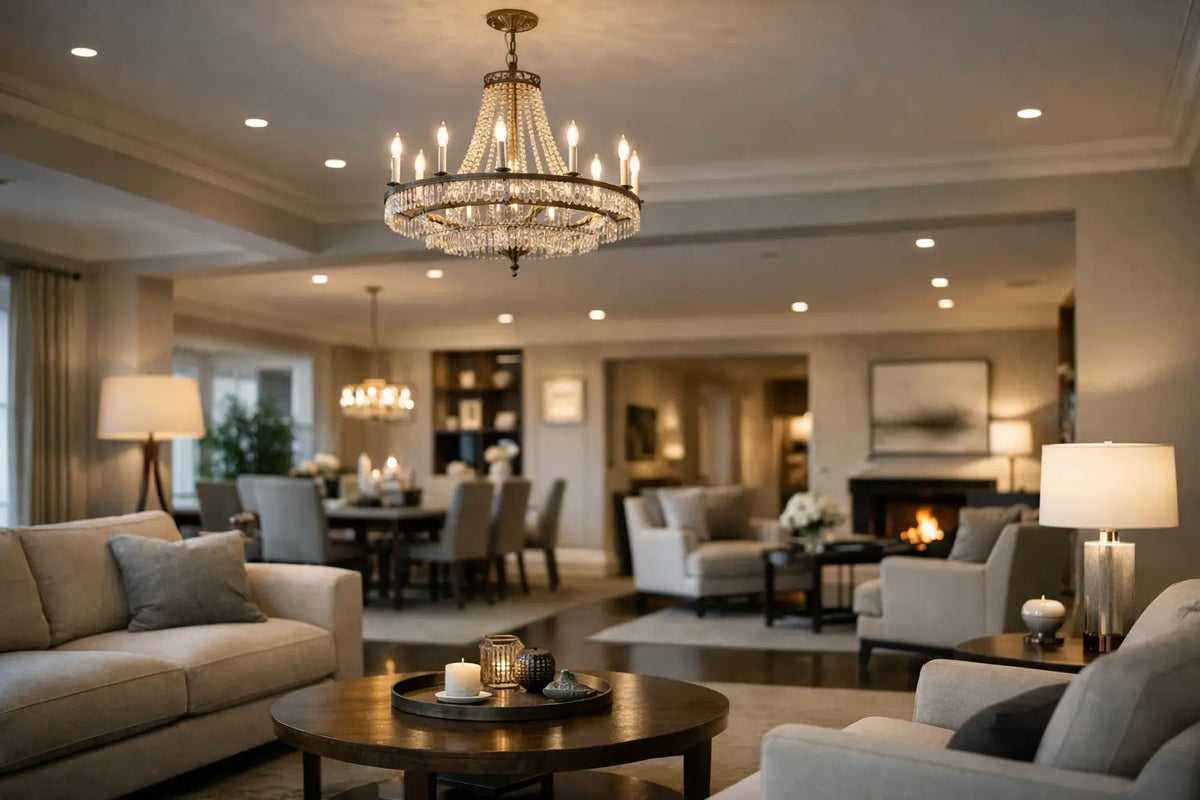
A generous drawing room can be beautifully furnished and still feel curiously flat after dusk. Often, the issue is not the furniture or the palette, but a single central light attempting to illuminate an entire volume. Learning how to layer lighting in large rooms means treating light as part of the architecture: a sequence of pools, highlights and gentle transitions that gives a room scale, purpose and atmosphere.
In substantial interiors, lighting should not make every corner equally bright. It should reveal the room in stages, drawing attention to the places where people gather, read, dine, converse or pause. The most convincing schemes feel effortless because their complexity is carefully concealed.
Begin with the room's architecture and daily rhythm
Before selecting a decorative fitting, consider the room as it is experienced. Its ceiling height, window positions, sightlines, wall finishes and furniture plan will all affect where light belongs. A double-height salon needs a different approach from a wide, open-plan family room with a modest ceiling, even where the square footage is similar.
Start by identifying the room's distinct zones. In a large living room, these may include a principal seating arrangement, a reading corner, a fireplace, a drinks cabinet, a piano, artwork and circulation routes. Each zone does not need its own visible fitting, but it should have an appropriate quality of light. This prevents the familiar effect of a chandelier illuminating the centre of the ceiling while the life of the room happens at its edges.
Think, too, about how the space changes across the day. Morning light may be predominantly natural; late afternoon calls for soft support near seating; evening entertaining benefits from a more theatrical composition. A considered scheme accommodates these shifts without requiring constant adjustment.
The three layers that give large rooms depth
The principle is simple: combine ambient, task and accent lighting. The execution, however, relies on proportion and restraint.
Ambient lighting establishes the overall mood
Ambient light is the foundation. It provides comfortable general illumination, allowing people to move through the room and understand its shape. In a large room, this layer is rarely best delivered by one decorative pendant alone.
Recessed downlights, discreet architectural uplighting, concealed coves or wall washers can provide an even, calm base. Their purpose is not to announce themselves. They should soften shadowy expanses and give the room a composed glow, particularly around perimeter walls and transitions between adjoining spaces.
The key is careful placement. Downlights arranged in a rigid grid can make a refined interior feel commercial, while too many fittings flatten texture and remove the intimacy that large rooms require. Position them in relation to joinery, artwork, circulation and furniture rather than treating the ceiling as an empty plane. In rooms with ornate plasterwork or lower ceilings, wall lights and concealed detailing may be more sympathetic than extensive ceiling punctures.
Task lighting makes generous spaces usable
Task lighting is focused illumination for a particular activity. It is where a room becomes genuinely comfortable rather than merely impressive. A reading chair needs directional light close enough to illuminate a page without spilling harshly into the wider room. A writing desk requires clear, controlled light, while a console may benefit from a softer lamp that supports both arrival and ambience.
Floor lamps are especially useful in larger rooms because they introduce vertical presence below ceiling level and help bridge a wide furniture arrangement. Choose a scale that holds its own beside substantial sofas and occasional chairs. A slender lamp may be elegant, but it can disappear against a high ceiling or oversized joinery.
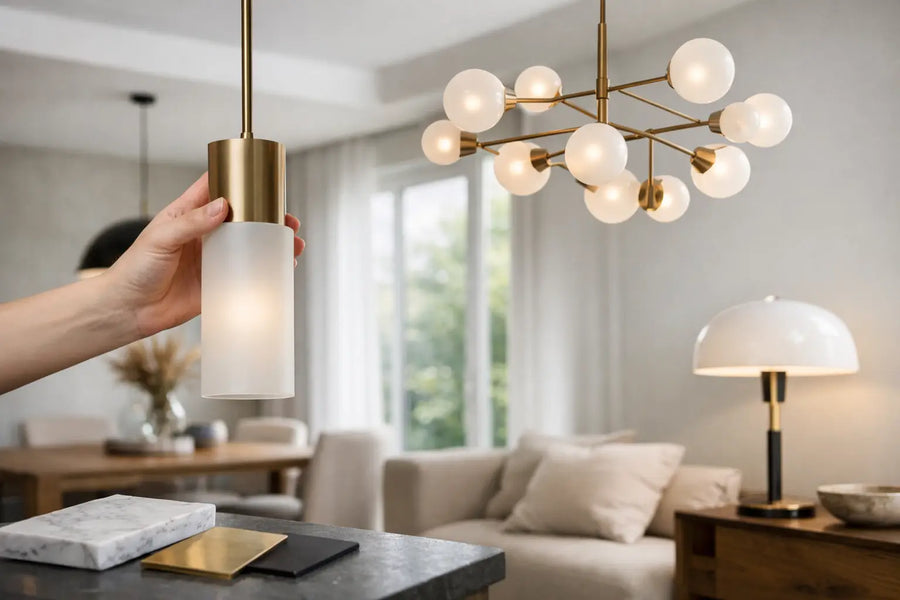
Table lamps bring another valuable layer: they make the room feel inhabited. Placed on consoles, side tables or cabinetry, they create warm points of focus at eye level. Their shades matter as much as their bases. Fabric, parchment and finely textured materials diffuse light gracefully, whereas exposed bulbs and highly reflective shades are often too insistent for relaxed evening use.
Accent lighting gives the scheme its character
Accent lighting is selective. It gives visual importance to a painting, sculptural object, architectural niche, textured wall treatment or carefully composed display. In large rooms, it is this layer that stops the perimeter from receding into darkness and gives the eye a reason to travel.
Use it with discipline. A beautifully lit artwork can anchor a wall; lighting every object on every shelf can create visual noise. The aim is hierarchy. Decide what should hold attention first, what should sit quietly in support, and what is better left in shadow.
Picture lights can offer a particularly elegant solution where their finish and proportions suit the interior. Alternatively, adjustable concealed fittings can provide a cleaner architectural result. For textured stone, timber panelling or specialist wall finishes, grazing light from a carefully judged angle can reveal material depth, though it will also expose surface imperfections. Sample testing is invaluable before committing to a fixed position.
How to layer lighting in large rooms without visual clutter
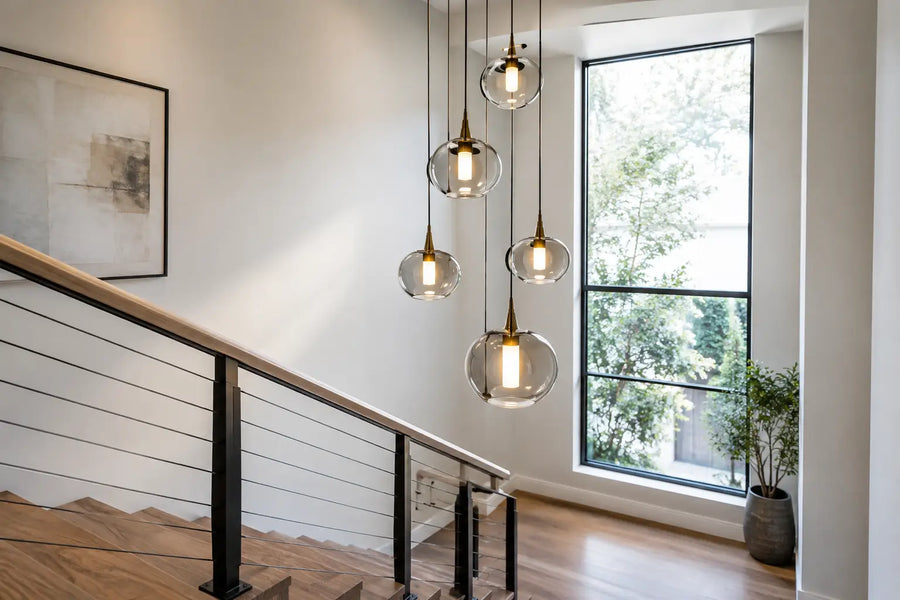
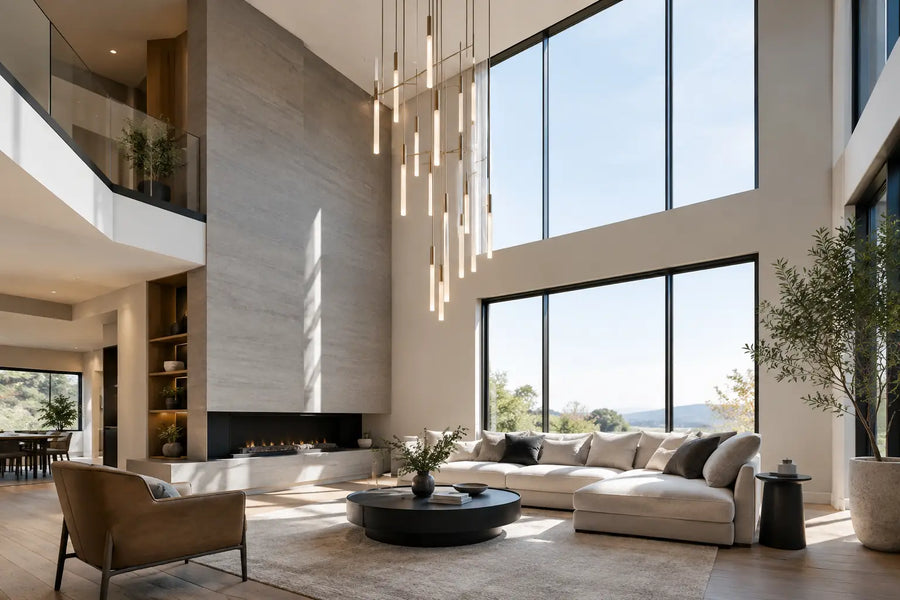
Large rooms can accommodate statement lighting, but scale should never be confused with quantity. One exceptional chandelier above the main seating area or dining table may provide an important focal point, yet it needs support from quieter sources around the room.
Consider the chandelier's relationship to furniture rather than the geometric centre of the ceiling. In an open-plan room, the centre may fall within a walkway, while the social heart of the space sits elsewhere. Aligning a decorative fitting with the principal furniture grouping creates a stronger sense of order.
Where a room has more than one seating arrangement, two smaller sculptural pendants may be preferable to one oversized fitting. Conversely, a single tall space may benefit from a dramatic central piece that occupies the volume with confidence. It depends on ceiling height, the architecture and how formal the room is intended to feel.
Avoid repeating every finish too literally. A bronze chandelier, bronze wall lights and bronze floor lamps can become overly coordinated. Instead, establish a family of materials and temperatures. Aged brass, dark bronze and warm natural stone, for example, can sit together with greater ease than matching fittings from one range.
Control is where a lighting plan becomes liveable
A layered scheme is only as successful as its controls. Every light source should be dimmable, with circuits organised around use rather than fitting type. Putting all downlights on one circuit, all wall lights on another and all lamps on a third may be convenient at installation, but it is not always intuitive in daily life.
A better approach is to create scenes. An arrival scene might bring up hall-facing lamps, perimeter lighting and a few wall lights. A relaxed evening scene could favour table lamps, firelight and low-level accent lighting, with overhead illumination reduced. A cleaning or daytime scene can provide brighter, practical coverage when needed.
Keypads or discreet controls near entrances and seating areas make this easy to use. In a sophisticated home, technology should reduce friction, not introduce another layer of complication. Retain simple manual control for principal lights, particularly for guests and household staff.
Choose colour temperature and lamp quality with care
For most residential living spaces, a warm colour temperature of around 2700K gives skin tones, timber, stone and upholstery a flattering, settled appearance. In exceptionally warm palettes, 2200K to 2400K can create a more intimate evening atmosphere. Cooler white light may suit utility-focused areas, but it can make a formal sitting room feel severe.
Colour rendering is equally significant. High-quality LEDs with a high colour rendering index reproduce artwork, textiles and finishes with greater fidelity. This is worth specifying carefully in interiors where material nuance has been a major investment.
Do not overlook glare. A bright source visible from a seated position will undermine even the finest fitting. Shade lamps appropriately, recess directional fittings deeply enough, and check sightlines from sofas, dining chairs and principal viewpoints before finalising locations.
Treat lighting as part of the wider design composition
Lighting decisions are most successful when made alongside the furniture plan, ceiling design, joinery and electrical layout, not after decoration is complete. A lamp may need a concealed floor socket; a sculpture may require a dedicated accent point; bespoke cabinetry may be designed around integrated illumination from the outset.
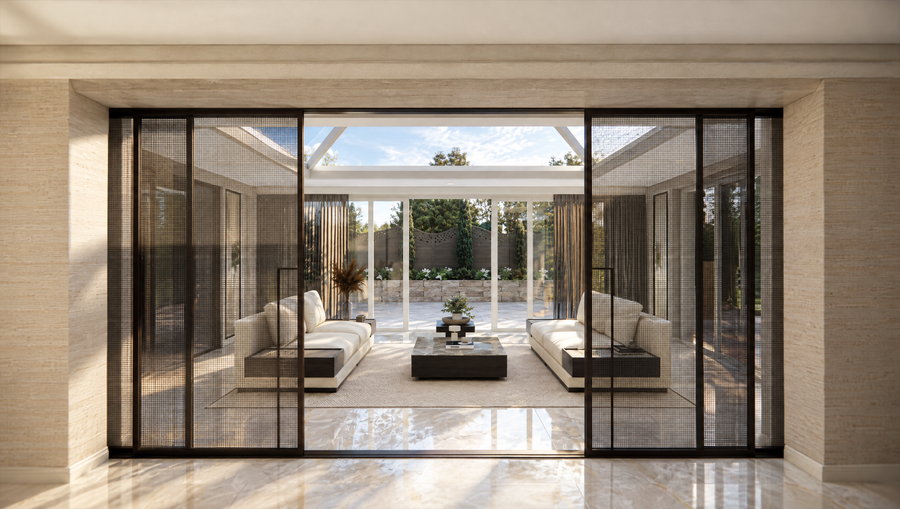
This is particularly relevant in properties with large expanses of glazing. At night, glass becomes reflective, and poorly positioned fittings can create distracting mirror images. Softer lighting set away from the glazing, combined with considered window treatments, will make the room feel more composed after dark.
At Touched Interiors, lighting is approached as a material part of the interior, with the same attention given to scale, finish, function and longevity as furniture and architectural detailing. The result is not simply a brighter room, but one that feels calm, dimensional and naturally suited to the way it is lived in.
The final test is simple: sit in the room after sunset. If the lighting guides the eye, supports conversation and allows the architecture to recede and reappear with quiet confidence, the layers are doing their work.
Touched Interiors
The Insider is written by the Touched Interiors design studio in Manchester, founded by Kunal Trehan in 2009 and named Interior Design Studio of the Year in 2024 and 2025. About the studio.