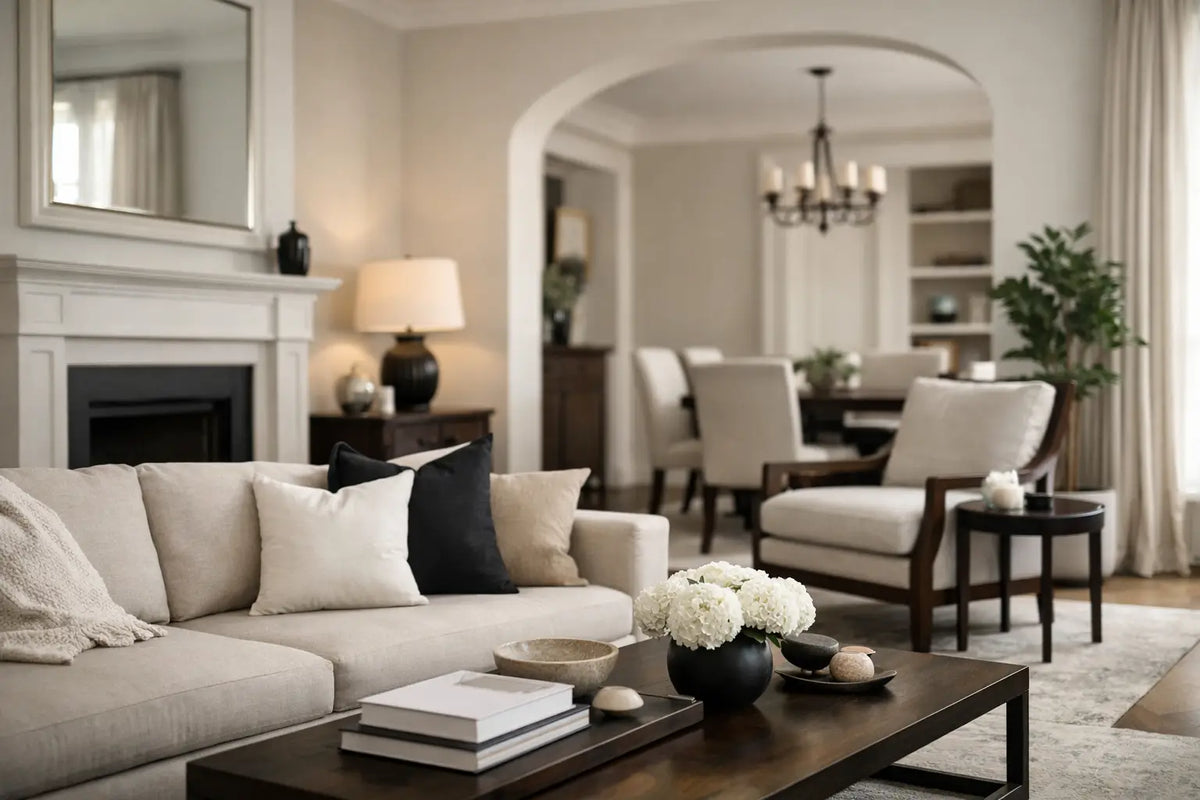
A modern classic home interiors guide begins with a useful distinction: this is not a period interior softened with contemporary accessories, nor a minimal contemporary scheme dressed in traditional finishes. It is a disciplined approach to composition, where architectural character, considered proportion and enduring materials are given a cleaner, quieter expression. The result should feel composed rather than decorated - a home with presence, but no need to announce it.
The appeal is particularly clear in substantial townhouses, penthouses and family residences, where clients often want rooms that respect the building while accommodating contemporary life. Modern classic interiors have longevity because they rely less on novelty and more on judgement: how a sofa sits within a room, how light travels across a wall finish, and where visual detail is allowed to rest.
What defines modern classic interiors?
At its best, modern classic design holds two ideas in balance. Classical design contributes order: symmetry, measured detailing, quality joinery and a clear hierarchy of spaces. The modern element introduces restraint: simplified profiles, edited ornament, generous negative space and furniture chosen for comfort as well as form.
This balance is easily lost. A room with heavily carved furniture, ornate mouldings and decorative metallic finishes can become overly formal. At the other extreme, stripping every surface back to pale paint and hard-lined furniture risks making a characterful property feel anonymous. The answer is rarely to divide the room into ‘traditional’ and ‘modern’ halves. Instead, establish a classical framework, then introduce contemporary pieces with enough scale and material substance to belong within it.
A high ceiling, deep skirting and original cornice, for example, may call for a low, sculptural sofa with a tailored silhouette rather than a reproduction settee. A sleek stone fireplace can sit comfortably beneath a traditional ceiling rose if the proportions are carefully resolved. Contrast is valuable, but it must be intentional.
Start with architecture and proportion
The most convincing schemes are planned from the envelope of the room outward. Before considering furniture, study ceiling height, window positions, circulation routes, natural light and existing architectural features. These conditions determine not only what will fit, but what will feel inevitable.
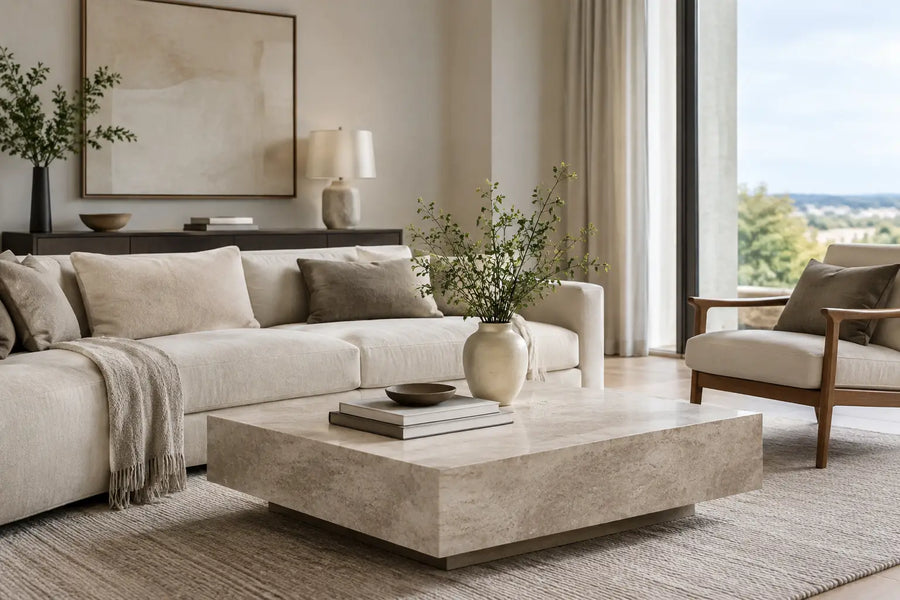
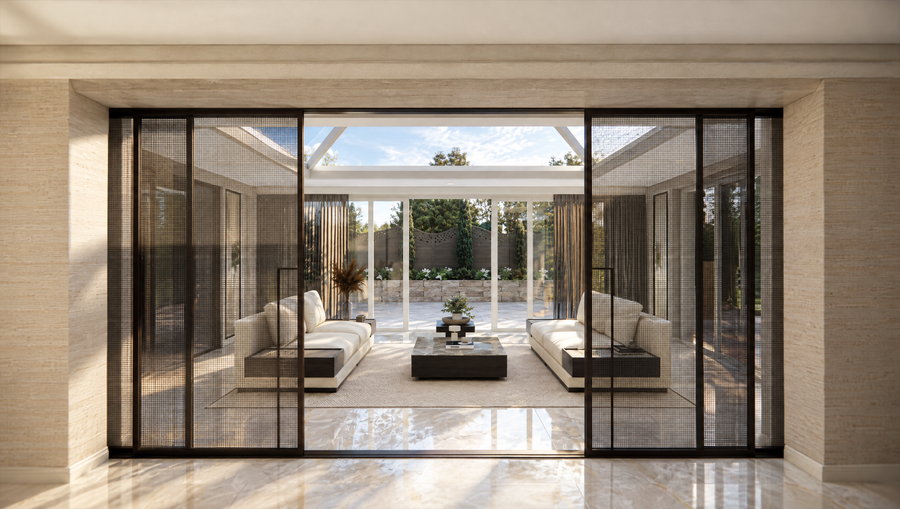
In larger reception rooms, furniture should create distinct areas without fragmenting the space. A pair of sofas facing one another may establish a formal conversation setting, while a pair of lounge chairs near a window creates a more relaxed secondary moment. The central table needs sufficient visual weight to anchor the arrangement, but it should not obstruct movement or demand excessive reach from each seat.
Symmetry remains useful in modern classic homes, though it need not be rigid. Matching wall lights or cabinets can give a room calm and order. From there, a single asymmetrical artwork, an irregular stone occasional table or a contemporary floor lamp prevents the composition from feeling staged. This measured tension gives the room life.
Scale is equally important. Undersized furniture is one of the quickest ways to diminish an ambitious room. In generous spaces, choose sofas with a substantial seat depth, curtains that are properly full, and lighting with enough diameter to hold its own against the architecture. Conversely, in a compact flat, a few beautifully proportioned pieces will have greater impact than an overfilled collection of small furnishings.
Build the palette through material, not colour alone
A modern classic palette is often described as neutral, yet neutral does not mean uniform. The most refined rooms use tonal variation and tactile contrast to create depth: warm ivory against chalky stone, walnut against soft plaster, brushed bronze against honed marble, bouclé against smooth timber.
Begin with the materials that are difficult to change. Flooring, joinery, stonework and wall treatments form the long-term foundation, so they should be selected for permanence rather than immediate fashion. Oak with a natural or smoked finish, figured walnut, hand-finished plaster, linen wallcovering and honed natural stone all acquire a quiet richness as light changes through the day.
Stone deserves particular care. A highly dramatic slab may be appropriate for a feature surface in a contemporary penthouse, but it can dominate a smaller or more traditionally detailed room. Veining, finish and scale should be assessed in relation to the whole scheme. Honed surfaces tend to feel softer and more architectural than a high polish, although a polished finish can bring welcome luminosity to a darker entrance hall or powder room.
Colour is most successful when it is layered rather than applied as an accent formula. Consider a field of mineral neutrals - mushroom, taupe, soft grey, parchment or muted olive - then deepen selected elements through timber, upholstery and art. A restrained dark tone, such as tobacco, oxblood or charcoal, can give a room essential definition. The key is to repeat it sparingly so that it reads as a thread, not a graphic interruption.
Choose furniture with clarity and craft
Furniture in a modern classic scheme should earn its place through silhouette, comfort and construction. Decorative excess is unnecessary when the proportions are right. Look for upholstered pieces with fine tailoring, well-resolved arms and a seat depth suited to how the room will actually be used. A formal drawing room and a family media room require different degrees of softness, support and resilience.
Bespoke furniture is especially valuable where architecture presents unusual dimensions. A made-to-measure sofa can align with a bay window, retain a clear circulation route and establish the right visual length on a principal wall. Similarly, a dining table designed around the room's axis, seating requirements and pendant position will feel materially different from an off-the-shelf substitute.
Case goods should introduce texture and permanence. Fluted timber, wrapped leather, bronze detailing and bookmatched veneers can bring refinement, provided the room is not asking every object to perform at once. Select one or two dominant expressions of craftsmanship, then allow quieter pieces to support them.
Lighting is the room's finishing architecture
Modern classic interiors depend on layered lighting. A decorative pendant alone may provide a focal point, but it cannot make a room feel comfortable at dusk. Plan for ambient, task and accent lighting from the outset, with circuits that allow each layer to be controlled independently.
Wall lights are particularly effective in this style because they reinforce rhythm along corridors, fireplaces and bedside walls. Their scale matters: small fittings can disappear against tall walls, while oversized decorative shades may compete with artwork or joinery. In living rooms, table lamps introduce the low pools of light that make upholstery, timber and textured walls feel inviting. Picture lights and discreet joinery lighting should be used with restraint, illuminating selected pieces rather than flattening every surface.
The quality of light is as significant as the fitting itself. Warm colour temperatures and high-quality dimming are essential in residential schemes. Cool, flat illumination can make carefully chosen materials appear clinical, while poor dimming can disturb the atmosphere of an otherwise considered room.
Detail without clutter
The final layer is where modern classic interiors either become personal or lose their composure. Accessories should have a relationship to the scheme: a hand-thrown vessel that echoes the stone, a sculptural object that responds to the lines of a console, books arranged with a sense of use rather than display. Leave sufficient space around each object for it to be seen.
Window treatments require the same discipline. Full-length curtains in linen, wool or a refined woven fabric soften architecture and improve acoustics, while discreet blinds offer privacy where needed. The heading, track or pole should be decided during planning, not treated as an afterthought. A well-proportioned treatment can make a modest window feel more generous; a poorly placed one can compress the room.
Art should not be used simply to fill blank walls. Consider its scale, viewing distance, palette and the light falling across it. One significant work above a fireplace or console is often stronger than several unrelated pieces. The same principle applies to decorative objects: select fewer, better examples with material interest and personal relevance.
A modern classic home interiors guide for longevity
Longevity comes from designing around how a household lives, not from avoiding personality. A pale upholstered dining chair may be entirely appropriate in a formal residence with infrequent entertaining, yet a family home may need performance fabric or leather that develops character with use. Delicate plaster finishes can be exceptional in a reception space, but a busy hallway may benefit from timber panelling, durable lacquer or a textured wallcovering that tolerates daily contact.
It is also worth planning for the parts of the home that are often overlooked: storage for technology, charging points, concealed television solutions, integrated speakers and practical lighting controls. These decisions protect the visual calm of the finished rooms. They are best addressed early, alongside joinery and electrical planning, rather than retrofitted after installation.
For whole-home projects, an experienced interior architecture and procurement team can maintain continuity across rooms while allowing each space its own mood. Touched Interiors approaches this through the combined consideration of spatial planning, bespoke detailing, furnishings and final styling, so that the home reads as one coherent narrative rather than a sequence of individual purchases.
A modern classic interior should feel settled from the first evening, yet reveal new qualities over years of living. Choose the elements that shape daily experience with care: the sofa that welcomes conversation, the stone that catches morning light, the lamp that changes a room after dark. Those are the decisions that give a home its enduring character.
Touched Interiors
The Insider is written by the Touched Interiors design studio in Manchester, founded by Kunal Trehan in 2009 and named Interior Design Studio of the Year in 2024 and 2025. About the studio.