A room can be highly fashionable and still feel dated within a few years. This is usually not because it lacks beauty, but because its decisions were made to echo a moment rather than serve the architecture, the people who live there and the life of the home. The most convincing timeless interior design trends are not really trends at all. They are enduring design principles, interpreted with enough personality to make a home recognisably its own.
For private residences, longevity is both an aesthetic and practical consideration. A considered interior should retain its composure through changing tastes, daily use, family life and evolving collections of art and objects. It should also allow carefully selected pieces to acquire character rather than needing to be replaced when the prevailing look shifts.
Timeless interior design trends begin with proportion
Before colour, furniture or decorative detail, there is scale. Proportion is the quiet structure behind a room that feels settled. It determines the relationship between ceiling height and lighting, the volume of a sofa in relation to a fireplace, the width of circulation routes and the visual weight of joinery against a wall.
In period homes, this often means respecting generous ceiling heights, original openings and architectural rhythm rather than filling rooms indiscriminately. In a contemporary penthouse or villa, it may mean bringing warmth and definition to broad, open-plan spaces through finely judged furniture groupings, rugs and ceiling treatments. The architectural language changes, but the principle does not: each element should have a reason for its scale.
A large room does not automatically require oversized furniture. Equally, small-scale pieces can make a substantial drawing room feel sparse and temporary. The answer lies in composition. A substantial sofa may need a pair of lower occasional chairs to vary the silhouette, while a generous dining table needs enough clear space around it for chairs to move comfortably. These decisions are felt before they are consciously noticed.
Design for movement, not just photographs
A timeless room performs well from every angle. Consider how a guest enters, where coats are placed, how drinks are served, whether reading lights reach their intended seats and how easily one can move around a dining chair once everyone is seated. Function does not dilute refinement. It gives refinement credibility.
This is particularly relevant in open-plan interiors, where a beautiful scheme can fail if it lacks spatial hierarchy. Distinct zones for dining, conversation and quieter retreat may be created through changes in ceiling detail, flooring direction, lighting and furniture orientation, without resorting to visual clutter or hard partitions.
Materials that improve with age
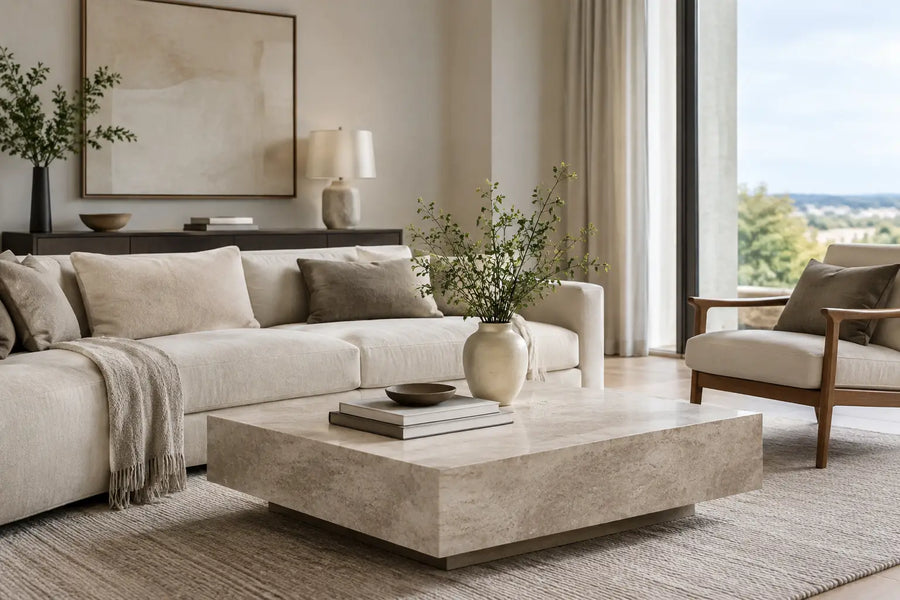
The strongest interiors use materials with inherent depth. Natural stone, solid timber, patinated metals, wool, linen, leather and finely made plaster finishes all reveal subtle variation over time. They are not immune to wear, but they tend to wear with dignity when properly specified and maintained.
That distinction matters. A polished marble floor may be entirely appropriate in a formal entrance hall, but not necessarily in a family kitchen where a honed finish may be more forgiving. Untreated brass will develop a patina, which can be beautiful in the right setting but frustrating for a client expecting a permanently bright surface. Timelessness is not about choosing the most precious material in every instance. It is about choosing the right material for the way a room will be used.
Timber is especially valuable for its ability to introduce warmth and permanence. Oak, walnut and smoked finishes can all endure, provided the undertone is carefully considered alongside the architecture and light levels. Overly orange, grey or artificially uniform finishes often tie a scheme too firmly to a particular era. A nuanced stain, visible grain and excellent cabinetmaking will outlast a fashionable colour treatment.
Layering is equally important. Stone gives coolness and permanence; timber adds warmth; upholstery brings softness; metal contributes definition and reflection. When every surface has the same sheen or texture, a room can appear flat, however expensive the individual components may be.
A restrained palette with room for character
Neutral does not have to mean beige, and timeless does not mean devoid of colour. The distinction lies in the depth of the palette and its relationship to natural light. Chalky mineral tones, warm ivory, tobacco, olive, oxblood, deep blue and softened charcoal have long-standing appeal because they have complexity. They change gently across the day rather than reading as a single, fixed note.
For a lasting scheme, it is often wise to reserve the most enduring tones for expensive, difficult-to-replace elements: flooring, stonework, fitted joinery and principal upholstery. More expressive colour can then appear in artwork, cushions, lampshades, occasional seating or a guest cloakroom. This does not make the interior cautious. It gives it the freedom to evolve without waste.
Pattern has a place, but its scale and application deserve discipline. A small, overly busy motif across multiple surfaces can quickly date a room. One beautifully woven textile, a hand-knotted rug or a tailored wall covering can carry pattern with greater assurance. The eye needs areas of calm around decorative moments.
Use contrast to create depth
Rooms with no contrast can feel anonymous. A pale scheme benefits from an ebonised timber detail, aged bronze, a dark-framed artwork or a richly coloured chair. Conversely, a darker interior needs moments that catch the light, perhaps through silk, lacquer, pale stone or antique mirror.
The aim is not drama for its own sake. Contrast gives the room legibility. It helps architecture, furniture and objects retain their individual presence rather than merging into one continuous surface.
Furniture with a clear purpose
Timeless furniture tends to have an intelligible form. Its silhouette may be classic, contemporary or a carefully calibrated combination of both, but it should appear resolved from every viewpoint. Fine proportions, quality upholstery, proper suspension, hand-finished timber and considered detailing matter far more than a recognisable label or a short-lived profile.
The most successful schemes balance tailored anchor pieces with individual finds. A bespoke sofa designed for the room can establish comfort and proportion, while an antique console, sculptural lamp or collected chair prevents the result from becoming overly prescribed. This conversation between eras is one of the surest ways to create an interior with genuine depth.
There is, however, a practical limit. Mixing periods does not mean assembling unrelated objects. Pieces need a common thread: similar timber tones, a repeated metal finish, compatible lines or an intentional palette. Without this, eclectic can become unsettled.
Commissioned furniture is particularly valuable where standard dimensions compromise a room. A dining table that is too narrow, a bed that overwhelms its wall or a sofa that interrupts circulation will never feel right, regardless of its finish. Bespoke design allows scale, comfort, upholstery and detailing to be resolved together, rather than treated as separate decisions.
Lighting planned in layers
A single decorative pendant rarely provides the light a room needs. Timeless interiors treat lighting as part of the architecture, with layers that support both daily routines and atmosphere. Ambient light establishes a calm overall level; task lighting makes reading, cooking, dressing and working comfortable; accent lighting gives depth to art, joinery and texture.
Decorative fittings still matter, particularly above dining tables or within entrance halls, but they should be selected for their proportion and craftsmanship rather than novelty. A well-made chandelier, a sculptural wall light or a finely detailed table lamp can become a lasting focal point when it is correctly scaled and sensitively positioned.
Controls deserve equal attention. Dimming, circuit planning and warm colour temperatures make a significant difference to how materials appear after dark. This is an area where technical detailing has a direct emotional effect: a room with thoughtful lighting feels composed, inviting and quietly luxurious.
What to borrow from current design movements
Contemporary preferences can offer useful ideas, provided they are filtered through the home rather than adopted wholesale. Curved furniture, for example, can soften rectilinear architecture and improve circulation, but too many exaggerated forms can make a room feel themed. Textured plaster walls offer tactility and depth, yet they should suit the existing architectural character and be specified for durability.
The current appetite for warmer minimalism has also encouraged a welcome return to tactile finishes, fewer but better pieces and calmer visual fields. Its lasting value lies in restraint, not in copying a particular shade of mushroom paint or a social-media-ready arrangement of objects.
A good test is to ask whether a choice would still feel right if the images associated with it disappeared. If the answer rests on comfort, craftsmanship, proportion and a meaningful connection to the home, it is likely to endure.
At Touched Interiors, the most enduring projects are rarely those with the fewest details. They are the ones in which every detail has been considered: the hand of a fabric, the line of a cabinet, the light cast across a wall at dusk and the ease with which the home supports everyday life. Begin there, and the interior will have every chance to become richer with time.
Touched Interiors
The Insider is written by the Touched Interiors design studio in Manchester, founded by Kunal Trehan in 2009 and named Interior Design Studio of the Year in 2024 and 2025. About the studio.